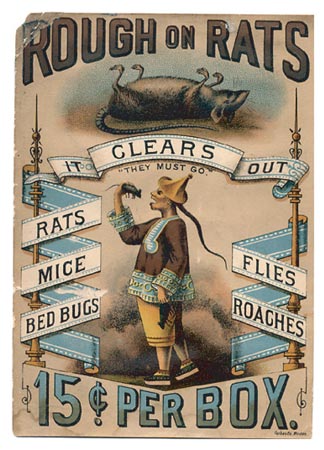
Historically, the United States has not had the best relationship with Asian countries. For the most part, Americans have been racist and rude to the Asians in America and to the Asians residing in their homelands from the late nineteenth century well into the 20th century. After viewing the slate slideshow and observing the image on the second slide, it can easily be seen that America portrays Asians in a negative light. In an advertisement for rat poison, there is a Chinese man holding a rat to his face on the verge of placing it in his mouth. There was a suspicion of the Chinese eating rats but the advertisement became even harsher by not just insulting their eating practices, but saying above the Chinese man’s head, “they all must go”. This infers that Chinese people are on the same level as rats, dirty and unhealthy, and that they need to get out in order to assure the safety of the citizens of America.
This advertisement is relevant to the time era because the Chinese Exclusion Act of 1882 was implemented years before this rat poison advertisement came out. There was a massive immigration from China to America in the late 19th century for economic opportunity, but America recognized that the Chinese were taking too many jobs and banned them from immigrating. It would explain some of the hostility that Americans would have towards Chinese, because their flock to the States must have affected many people in their attempts to find jobs and make a living. It would have instinctually made American citizens dislike the Chinese, because they were taking American jobs and leaving the people who were born and raised on American soil without homes. The Americans would associate the Chinese with rats in this advertisement, and they would be more inclined to purchase the product to have the nuisance of rats out of their homes. Obviously this advertisement generalizes all Chinese by saying that they consume rats for meals, and this makes this advertisement racist. But by putting the Chinese in a negative light, it made the advertisement more effective because the American consumer could relate to having a dislike for the Chinese with having a dislike for rats, and would want both of them gone.
I recognized how this piece of media relates to a modern-day ad that also displays Asians in a poor light. I discovered an advertisement where Jackie Chan is promoting clothes. In this ad Jackie Chan wanders in the room asking the two characters if they are ready to go to the party. He has a thick accent and it makes him seem less intelligent, along with the fact that he is going to a party with two stuffed animals. When they stand up and the dolls are both naked, one of them travels to get clothes. In the meantime, a character makes a remark about wax on wax off, a famous quote from the Karate Kid, a movie in which Jackie did not make an appearance. This instance makes a generalization that all Asians look similar and that is proven because the doll cannot tell the difference between the real actor in the Karate Kid and Jackie Chan. When the other doll returns from the store having bought a wrestling suit, Jackie immediately jumps into a fighting pose. This supports the stereotype that Asians are masters of the martial arts, and will be ready to use their skill at any time. The advertisement ends with Jackie leaving the room with one of the dolls hanging in a lantern. This advertisement would have appealed to a general audience, because the entire ad wasn’t based off of the product it was selling. It would have appealed to children interested in fighting, because they would watch this clip and immediately associate Jackie Chan’s fighting skills with the clothes advertised. Jackie Chan came into the ad acting friendly and left with a grin on his face after he beat up one of the dolls. This sends off the message that Jackie Chan is mischievous and not a loyal person to his friends.
This advertisement relates to the old rat poison advertisement because the Chinese are still not being shown in a very positive light. Although the ad doesn’t have Jackie eating a rat, it does have him speaking in a very strong accent and fighting off clearly unskilled martial artists. This gives off a bad reputation for the Chinese because it makes them look like they cannot speak proper English, that they are not loyal friends, and they use their martial arts skills to harm their peers. This ad has not changed the image of the Chinese too much in the last century, but the insults that the advertisements lay on the Chinese are nowhere near as harsh as they were one hundred years ago.

